Wednesday, May 21, 2025

The Shock of the Newcastle


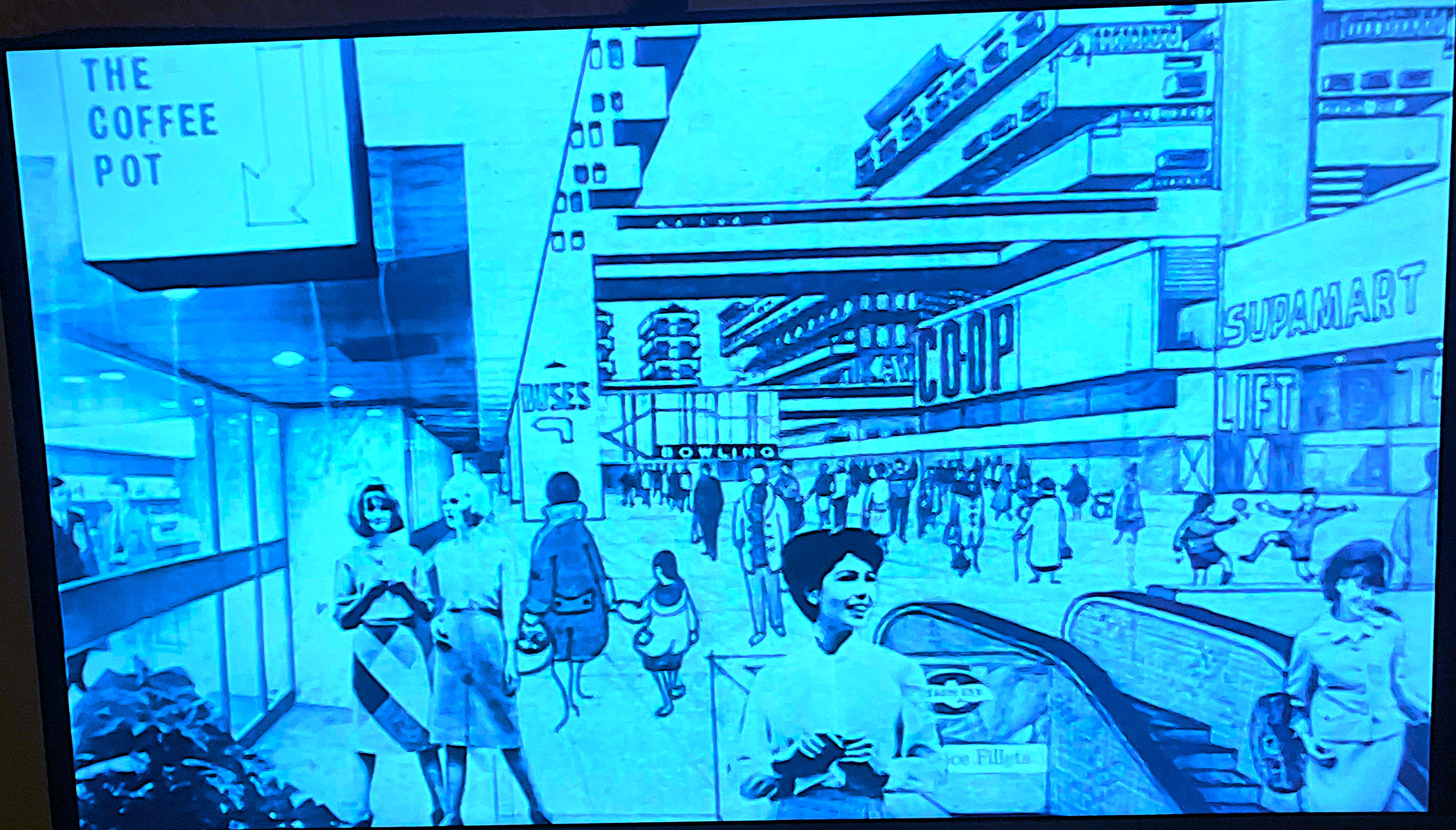
Snapped off the TV from a YouTube British doc about Newcastle in 1966. Mostly about the vibrant youth culture there but it does show this architect's mock-up of plans for a revitalized and modernized pedestrian-only shopping center in the city.


Here's another view of the city from the wonderfully elegaic archi-critic Ian Nairn


I wonder if with that pained voice - he always sounds like he's wringing his hands, on the edge of tears  - Nairn could only have been an epigone? 

Or did the elegaicism condition and create the highly-strung voice? 


I've been to the city just once, in the early '80s - it is an exciting looking place. That bridge!

Three other things I remember from my visit:

Stotties

Pease pudding

A passer-by ejecting from his nostril into the gutter a long string of snot. Never seen that before, nor since I don't think. 


Friday, May 2, 2025

Future Schlock


"Schlock" here used in the Yiddish-derived sense of "inferior or shoddy goods"

Oops, here's an earlier Hawkwind-related release one that isn't quite as eyeball-affronting  


Topic for discussion - the decline of record cover artwork. Every time I open a streamer and check out "Suggested New Albums for You", my eyes are assaulted. It's across the board, from obscure artists to prestige ones, major labels to minor labels. I can't remember the last time I saw a truly surprising or even attractive record cover. It makes sense that in the age of streaming it would have declined as a point-of-sale factor but... there's still this thriving vinyl sub-market, there's still artists who grew up with the notion of the beautifully packaged record and presumably care about how their releases manifest as objects in the world. 

These are today's offerings at Tidal 


The Jenny Hval one is tasteful and moderately intriguing... the Lucius dog-bared-teeth-snarl grabs the eye... There's a few that are so misconceived they become almost-interesting

Beyond the question of the revolting artwork, the algorithm's ideas of what might appeal on a purely audio level seem misconceived.... I can't correlate these suggestions with my recent listening apart from the inclusion of an ECM title

 
postscript: added this Prince album covers graphic in reference to a comment


Sunday, April 13, 2025

The Voice of Space


Described by someone on the internet as one of the great science fiction images of the 20th Century - wonder if Rene M thought of it that way? Somehow doubt it....

Well, he described it thus -  "I caused the iron bells hanging from the necks of our admirable horses to sprout like dangerous plants at the edge of an abyss" - so no, it's not a s.f. image.

But apparently there is a science fiction anthology that used it as the front cover. 

And then there is J.G. Ballard, a big fan of Magritte along with the other Surrealist painters

"The Voice of Space" above is just one - and the most foreboding - version of the same painting, of which there are four


Talking of space, and infinite blackness, here is this missus on Black Mirror's USS Callister micro-series.... techbro incels, the virtual nerdiverse of Space Fleet as a kind of off-world detention centre....


Thursday, April 3, 2025

Science fiction and music

Strange Stars: David Bowie, Pop Music, and the Decade Sci-Fi Exploded, by Jason Heller

4columns, June 2018

By Simon Reynolds


Strange Stars starts with author Jason Heller recalling a profoundly formative experience: a David Bowie stadium concert in August 1987, when the Glass Spider tour reached his hometown, Denver, Colorado. Not the most auspicious initiation, perhaps: generally deemed a garbled farce of overdone spectacle, Glass Spider might be the nadir of Bowie’s increasingly rudderless eighties. Still, for fifteen-year-old Heller, the sound and vision—“a tornado of catsuits, astronaut costumes, and gold lamé”—blew his mind. The wonderment of that night propelled him along his life-path: a parallel trajectory that entwines being an active musician in various bands and an acclaimed science-fiction writer. (Author of the counterfactual satire Taft 2012, Heller also won a Hugo Award for his contributions to the magazine Clarkesworld.)


Coming at his subject, the interface between popular music and science fiction, from an unusual angle—as a practitioner of both s.f. and music, rather than rock critic or historian—gives Heller a fresh perspective. One fascinating thread concerns the surprising number of direct collaborations between rock bands and s.f. writers. Admittedly, they’ve rarely reached fruition: Theodore Sturgeon, for instance, was invited by Jefferson Airplane’s Paul Kantner and ex-Byrd David Crosby to turn their song “Wooden Ships” into a screenplay, but the process collapsed amid an excess of egos. Heller’s deep familiarity with his genre’s history also enables him to cross-reference the publication of landmark books with songs that appear to have borrowed from them: Bowie’s 1967 song “We Are Hungry Men”—a comic satire about an overpopulated near-future—was recorded suspiciously shortly after the final portion of Harry Harrison’s Make Room! Make Room! was serialized in the UK.


Despite being a musician, Heller’s approach in Strange Stars is largely lyric-based, treating songs as “a vehicle for science fiction.” He quotes from Kodwo Eshun’s More Brilliant Than the Sun but oddly doesn’t make use of the Afrofuturist critic’s concept of “sonic fiction”: the ways in which production, effects, timbres, and other futuristic or spacy audio elements create effects of disorientation and estrangement. Take “Silver Machine” by British cosmic rockers Hawkwind: it’s the sound of the single—Chuck Berry riding a Mercury rocket rather than a Chevy, a vertiginous whoosh into the beyond—that transports the listener, rather than the half-buried lyric about a vessel that “glides sideways through time.” Likewise, Bowie’s Low—devoid of s.f. lyrics—feels more science fiction thanks to its innovative production and brittle, neurotic rhythms than Ziggy Stardust and Diamond Dogs, whose songs about alien messiahs and Orwellian dystopias come clad in relatively conventional rock settings.


Although Bowie’s name is highlighted in the book’s subtitle and he appears often enough to approximate a narrative spine, one can’t help wondering if this slant was intensified after the glam rock visionary’s 2016 death, reframing what was originally intended as a broad survey of the s.f. influence on seventies pop music. But that 1970s emphasis itself also stirs a wrinkle of doubt. For sure, Heller’s list of definitively seventies genres—“Krautrock, glam, heavy metal, funk, disco, post-punk”—all deployed imagery related to the future, space exploration, etc. But pop’s infatuation with s.f. started well before 1970 and continued to flourish into the eighties (the era of synth pop, industrial music, and electro) and nineties (rave culture and techno).


Despite those somewhat arbitrary boundaries, Strange Stars provides a brisk and entertaining tour through terrain that has not been mapped at book length before. The briskness does have a downside. Strange Stars is structured as a year-per-chapter arc through the seventies, which means that the same figures keep cropping up, but often in a glancing way before we hurry on to the next example. Whenever the narrative slows and zooms in, it’s a richer read, as with sections on Hawkwind’s relationship with doyen of the British New Wave s.f. scene Michael Moorcock, Devo’s Spengler-retooled-for-MTV vision of humanity’s degeneration, and Poly Styrene of X-Ray Spex’s lyrical fantasias of consumerism-gone-crazy.


At other times the book can feel like a hectic and overly wide trawl that often pulls in things only tenuously connected to s.f. (a song that references a planet, a robotic dance style briefly in vogue). Midway through, I began to feel that while a formidable accumulation of evidence was underway, the case actually being argued had yet to emerge. Clearly there is a deep connection between rock and science fiction. Both forms operate within an uneasy but potent interzone between lowbrow and lofty, juvenile trash and avant-garde bohemia. But why haven’t other pulp fiction genres—westerns, hardboiled detective stories, mysteries—bonded with rock to anything like the same extent?


As Heller notes, it’s striking that several of the very first magazines containing rock criticism were launched by figures who came out of the s.f. fanzine scene. Later, music papers like NME would regularly profile writers like J.G. Ballard. Science fiction and rock both have an association with youth culture. While some stick with either or both for their whole lives, fanatical involvement is generally associated with adolescence and the early twenties. That super-intense seriousness—seeing s.f. or rock as a world-transformative force, or as a world unto itself—is an overestimation you’re supposed to grow out of.


But why is the affinity between rock and s.f. so strong, and what is the connection with youth? A clue can be found in a Bowie song mentioned in the book largely because of its title: “Life on Mars?” Heller rightly points out that the lyric isn’t really science fiction. But the song scenario and its emotional tenor do evoke exactly the sort of longings and frustrations that fuel “the desire called utopia,” the poetic subtitle of Fredric Jameson’s s.f. study Archaeologies of the Future. Bowie’s own account of “Life on Mars?” is that it’s about “a sensitive young girl’s reaction to the media.” Formulaic entertainment offers no relief (“the film is a saddening bore”), TV news presents a panorama of absurdity (“the workers have struck for fame”), and humanity in all its futile striving seems lemming-like (“the mice in their million hordes”). The question of the title is at once an indictment of the sheer mundanity of life on Earth and a sighing entreaty: there must be more than this, an absolute elsewhere.


Good on the details of s.f.’s interactions with rock, Strange Stars never addresses this deeper commonality: the fact that it’s the insufficiency of the world as is—and the inadequacy of the half-formed adolescent self—that drives kids into the fantasy-systems of science fiction and rock. Both offer ways of being “anywhere but here, anyone but me” through heroic narratives of discovery and danger. The feeling of risk is crucial: indeed, you could twist Jameson’s phrase and talk about “the desire called dystopia.” As shown by the contemporary boom of YA fiction set in totalitarian near-futures, or by the catastrophe sub-genre of sci-fi, it’s even more exhilarating to imagine being tested by extreme predicaments or struggling to survive in a radically (and thrillingly) transformed world. As the novelist John Wyndham—quoted in Strange Stars by Neil Peart, Rush’s drummer and lyricist—once put it, science fiction is about “extraordinary things happening to ordinary people.” That is a large part of rock’s promise too, for fans and for aspiring stars alike. 

Monday, February 17, 2025

Booker Contra The Future


Christopher Booker's The Neophiliacs: A Study of the Revolution in English life in the Fifties and Sixties  was published in 1969. It's well worth a read, despite - or rather because  - his take on the 1960s is so unsympathetic.

The overall theme is the idea of Sixties neophilia as a kind of collective national hysteria, a mass delusion, a mirage caused by the media that became self-perpetuating, stoking an appetite for shocks of the new and breaks with tradition... leading to an upward-spiraling demand for change that couldn't be satisfied, short of revolution. It could only crash and burn into bitterness and disillusionment. 

Brooker is a persuasive enough writer that even a "Sixties fan" like myself began to feel like it was all quite insane. At the same time, you gradually become aware that his worldview is basically Christian - I'm guessing in the high Anglican tradition, moderation in all things, non-fervent. He views society as - ideally - homeostatic. Things should change only very very slowly indeed - and perhaps not at all.  You sense that he not-so-secretly believes that things were better and people were happier when everyone knew their place.... The right attitude to have is humility and fatalistic acceptance of your God-given lot, rather than striving to get above yourself, or shake things up.

Curiously, Booker was a player in the British Sixties early on as one of the writers on That Was the Week That Was. So he was instrumental in the whole Sixties satire boom - with its groundbreaking irreverence towards authority (e.g. the impersonation of  Prime Minister Harold Macmillan - something deemed unthinkably disrespectful in 1962 or whenever it was).  He was also involved in Private Eye.

But by the time of writing The Neophiliacs, Booker has switched over to the other side and the satire boom is something he criticises. 

But then he criticizes everything: fashion, the cult of photographers like David Bailey, commercial TV, the dissolving of class barriers, permissiveness, the Pill, feminism,  Brutalist architecture, urban planners, Harold Wilson's "white heat of technology"...

He's possibly the original young fogie. 


America gets blamed for a lot - rock'n'roll obviously, but also for the arrival of supermarkets in the U.K. And if I recall right, he blames Americanization for the liberalisation of gambling laws, with casinos opening in London for the first time.

Another thing he doesn't approve of is James Bond movies!  On account of the way they glamorise sex and violence (which Bond clearly enjoys).


Wish I had this edition rather than the one up at the top....


One thing's for sure, Christopher would have hated, hatedExpo 70

Even if you already know a lot about the British Sixties - from more sympathetic historical accounts like say Robert Hewison's Too Much: Art and Society in the Sixties, 1960-1975, or frontline real-time takes  like Jeff Nuttall's Bomb Culture, Richard Neville's Playpower, or George Melly's Revolt Into Style - the Booker-book is worth a peruse I'd say, for the quirky way he's goes about assembling the narrative, as well as the less-common conservative perspective. 

He has a peculiar methodology, which is that he appears to have sat there with piles and piles of newspapers and ploddingly worked his way through the late Fifties and the Sixties year by year, month by month, week by week, day by day. On one level, that's lazily linear and pedestrian:  a chronicle, insufficiently analytic. But on another, it's fascinating - you get to know what the weather was like and how that affected the national mood. All kinds of little stories get included that a historian of the era operating later on might not have swept up. A reference to a "power breakfast" that David Frost held with all kinds of cultural bigwigs and movers and shakers attending. Something I'd never heard of, no doubt a big deal at the time, at least for a few weeks, but subsequently utterly erased from the memory.

Another interesting tic is the way Booker -  being a bit of a snob, or more charitably, acutely class-conscious - will mention what school someone went to, whenever he introduces a significant new character to the narrative. Or what university. It all feeds into his running theme of how the old social barriers were collapsing, an unprecedented degree of cross-class hobnobbing was going on. Which he probably found consternating. 

There was a follow-up to The Neophiliacs, not written as a book-book but compiled out of articles and opinion pieces: 


However it's not so much that the 1970s  is "the decade that changed the future" -  rather it's the decade where the future died. Or at least where the idea of the future, the romance of the future, faded and fizzled. That's what Christopher says. Faith in a brighter tomorrow, anticipation, eyes on the horizon, we are the tomorrow people  - he thinks all that goes, under multiple pressures (economic decline, environmental devastation, the oil crisis, the break-up of families through divorce, you name it - the laundry list of right-wing bogeymen). Hence the boom for multiple simultaneous nostalgia revivals....

 (But there's plenty of evidence for continued neophilia and future-anticipation in the 1970s- look at Tomorrow's World, Omni magazine, books of futurology, the aesthetics of disco and glam). 

I guess The Neophiliacs and The Seventies are Transatlantic cousins of Alvin Toffler's famous work Future Shock but Toffler is more diagnostic, whereas Booker is just aghast, recoiling in horror and disgust.  


Blank-eyed dollies in space age fashion juxtaposed with urban bleakness or Brutalist architecture  - this is a special bugbear of Booker's


Of course, he became a strong supporter of leaving Europe...


Just one of his anti-EU tomes. 


Now I wonder if Booker actually coined the term "neophiliac"?

And what would its opposite be? 

Not retrophiliac, because "retro" is always a present-day version or revision of the past - it says more about today than it does the actual historical past. . 

Whereas loving the actual past in all its deadness and gone-ness.... antiques and long-ago glories..

hmmm

Paleophiliac? 

Tuesday, February 11, 2025

これは明日だった (This Was Tomorrow)


Coulhart a/k/a { feuilleton } on Expo 70 in Osaka


There is a brief mention in Retromania of Expo 70 on account of what Karlheinz Stockhausen did there: 

Stockhausen had a spherical auditorium built to his specifications at the 1970 World's Fair in Osaka, Japan, with nests for musicians scattered throughout the audience; the latter sat at "the equator", on a sound transparent platform, and surrounded by fifty speakers distributed in ten circles (eight above the equator, two below).

There is a whole account of it here


This is one of the compositions performed 


Despite the title resemblance, this is something else - pretty cool sounding, though, and love the record cover


Someone - I think it was Rem Koolhaas - said Expo 70 was the peak of the 20th Century and that's it been downhill all the way since, in terms of human imagination. The swansong of the era of big public projects, governments prepared to plan things that took decades to be realised and that they'd not benefit from electorally, state action with a long-term focus rather than short-term with an eye on the next election. 


But there's a lot of gauchely futuristic buildings that have been built in the last couple of decades - London is overrun with them, things that feel like intrusions into realspace of digitally imagined architecture. And then you have the whole megacity ultramodernist thing of Dubai and Shanghai.

Still, none of it has that mid-century utopian aura - it's corporate power flexing itself, imposing on the skyscape. Mostly coming out of the private sector, right? 

The future now - in that brash teenage hard sci-fi distinctly old fashioned sense - seems to be owned, as a site of enthusiasm, by your tech-bro oligarchs. They are the "I heart eyesores" contingent  of today. The "sores" has a different inflection beyond the aesthetic, it's like gashes in the cityscape left by disruptor capital. 

(Likewise Trump's disgusting conception of Gaza as a potential real estate development bonanza.) 

Realtor-futurism. 

I have not yet seen The Brutalist, perhaps this is relevant. 

At any rate I personally now am more interested in seeing bits of England I never got to see than ever getting to the Moon or Mars. 

I wouldn't want to live in the house - or apartment - of the future either.  Those sort of desires seem arrested-development type desires. Child-man desires. 

Perhaps as you get older, you become more painfully aware of what's disappearing than exhilarated by the thought of things ahead - especially given you won't get to see them owing to your rapidly shrinking lifetime. 


A Telex from yesterday's future

An example of what I call "the rhetorics of temporality" - the way critics compulsively position and reposition things they like, ...