Sunday, August 11, 2024

techno before techno / electro before electro


1980, from Akron


1977, from London via Minnesota / Denmark / Alabama / Tennessee / Quebec 


A Red Bull Music Academy piece by Christine Kakaire on the story behind Cat Stevens's innovation-anomaly "Was Dog a Doughnut?"

"Rolling Stone considered “Was Dog a Doughnut?” to be one of the few “weaknesses” of Izitso. The album review, from July 1977, took an otherwise positive view of Cat Stevens’ second-to-last album, prior to his conversion to Islam and the subsequent abandonment of his career. Yet Cat Stevens’ least likely and most covert crossover hit was breezily dispatched with the following: “The electronics on (it) are a bit too robot like.”...

... even in the context of this relatively progressive album “Was Dog A Doughnut?” remains conspicuous. There is no trace of Cat Stevens to be found. It is entirely instrumental, and rides on a rigid, stuttering drum loop. A square wave riff repeats itself across a spectrum of layered frequencies, with parts appearing and vanishing at will. A barking dog provides occasional punctuation....

In the space of one day that summer, Stevens, and his two key collaborators – multi-instrumentalists Jean Roussel and Bruce Lynch – joyfully veered off the beaten path of folksy balladeering, with little in the way of context to steer their unexpected results. What they found by accident – a synth effect that sounded like a barking dog, a sequencer that missed a pulse and defined a groove, a wormhole into the future of electronic funk – was the first draft of the blueprint needed for electronic music to come of age.

Bruce Lynch:

I had an ARP Sequencer, and it’d had a modification done by Roger Linn, who invented the LinnDrum. The modification was called one-shot, you could put an audio sound into it and it would turn it into a trigger. Click tracks were used more often than not in the film industry, playing in orchestras to film, but sequencing was not big in those days.

So we established that we were going to do a track with all this stuff that we had, just for fun. What I brought to that was the idea of putting that pulse on tape, and it worked. The ARP Sequencer relied on 16 steps and sliders that would do the pitch, and you had a little button that had a gate that triggered a note. We could only have a bar at the start. Of course it could do drums, but on this particular bit the drums were a real kit. Yusuf played the drums to a prepared click track. That was recorded to the 24 track and we mixed it down.

We selected a bar of the drums, might have been two bars, made the loop; we took a quarter inch piece of tape and spliced it together and ran it through the deck. We had to keep this tape running for the duration of the song to get it back onto the multi-track, which was in line with this little 16th note pulse that we had.

One of the most significant bits is that sometimes the sequencer would drop a bit of information, or not read the incoming pulse, and there’s one piece where this riff is happening but it dropped a pulse, so it’s actually kind of syncopated. It was not meant to be like that, it was like, “Oh, that sounds really nice.” So it stayed in.

It was a collaborative effort, we were all diving away at buttons, manipulating sliders and voltage control oscillators and filters. We were just so interested in the way of doing something that was not sitting down with a live band. It was almost a little bit self-indulgent.

"Perhaps spurred on by the mid-’70s chart success of synth pop oddities like Hot Buttered’s “Popcorn” and Kraftwerk’s “Autobahn,” “Was Dog a Doughnut?” became Izitso’s second (and final) 12-inch release, in November 1977. It fell short of the Top 40 success of “(Remember The Days Of) The Old Schoolyard"” only reaching #70 on Billboard’s Top 100 Chart. However the first hints about the track’s alternate life could be seen in Billboard’s R&B Chart: “Was Dog a Doughnut?” rose to #53 in January, the only track of Cat Stevens’ to ever cross that colour line.

Questlove: "It was really just him creating a filler cut, experimenting with some electronic instruments – he fucked around, man, and created a B-boy classic"  

“Was Dog A Doughnut?” [became] a signature track of John “Jellybean” Benitez’ DJ residency at seminal New York club The Funhouse in the early ’80s....he released a freestyle remix of it in 1984 under his own name


Not much information out there about Denis DeFrange

Denis DeFrange is a synthesist, keyboard player, vocalist, and songwriter from Kent Ohio. He helped to form the Progressive Rock band, Baby Sirloin, which played the rock circuit in Cleveland Ohio back in the 1970's. He also released some of his own solo electronic tracks on the Akron compilation, Bowling Balls From Hell. He now operates Synthsong Productions Studio in Hollywood Hills California

"Sector Wars" (it's a very Cybotron sort of title, isn't it?) appeared on this compilation on the Clone label - along with five other tracks by Defrange that are similarly synth-y and impressively atmospheric if not quite as techno-preemptive. 


The whole compilation 


A search for a Denis DeFrange interview turned up an archive of the Daily Kent Stater, a college newspaper,  and specifically a February 1980 issue that has a feature on local New Wave activity. Access blocked, unfortunately, so only this tantalising wisp was salvageable:

"In a recent interview, DeFrange explained that a synthesizer can practically play ..".


Wednesday, August 7, 2024

take the plunge

 I had a great chat with Paul Rose - a/k/a Scuba a/k/a the man behind Hotflush Recordings -  for his Not A Diving Podcast. We talked about Futuromania, electronic dance music, back in the day blogging, and much more besides. Dive in


Saturday, August 3, 2024

Monday, July 29, 2024

The Futurist


An album that was never officially released but given away to friends.

"The cover of the album contains 779 names—one for each copy of the album. At the bottom of the cover is a blank space for anyone not named on the cover to write their name. Each person who received the album got a copy with their name circled on the cover; this was done for identification of a "culprit" should the album ever end up for sale.The Futurist was never released commercially. There is speculation that this was because Shellac were not satisfied with the finished product."

Not much of a gift then! 

Oddly, I once invoked the Italian Futurists in the context of Big Black:

"Big Black's anti-Romanticism was signaled very clearly in the sleeve note salutation on Songs About Fucking to "all bands who don't write love songs", which recalled the Futurists' proclamation that the nude in painting was an exhausted idiom, sentimentalized and enfeebled."

Would you believe, I have never listened to Shellac  - until today.

After Rapeman, I didn't bother with Albini's musical efforts.  

Listening to At Action Park, I didn't feel like I'd missed a whole heap. 

The Brillo Pad guitar sounds like someone fixated fairly fruitlessly on trying to replicate - without exactly repeating - the impact that Andy Gill / Bruce Gilbert / et al - had on him at an impressionable age.  So not really Futurist -  Past-ist, if anything. 

I've had more time for Albini as thinker and opinionator  - I don't think there's been an interview, or a piece of writing, that he's done in ensuing decades that didn't have something in it that made me think, even if the thinking was to work out why his opinion was bullshit. He did work hard to achieve and maintain consistency in his ideas about aesthetic integrity and the right(eous) way to go about being a band. Anybody who attempts to formulate a system of ideas and values - even at the risk of rigidity and self-dogma -  is worth paying attention to.  

I found myself nodding at these acerbic remarks about Zorn - from an Invisible Jukebox in the Wire, probably '94, or '95 - even as they nestled amidst absolutely ridiculous opinions about Black Sabbath and The Beatles. 


Thursday, July 25, 2024

fremtidigomani


International Times no 42 - 1968 October 


Four Front?  Never heard of that series before.

But here it is

First mentioned in Gramophone in November 1968, the series was named for the four parts It would concentrate it's releases on; Musica diversa, Organ, Electronic and Percussion, and Poetry and Prose. The records would Retail at 27s. 11d.


"Take an electronic trip with the most with it label on the market"  - this ad slogan is delicious because I am fairly certain that by 1968  - and certainly in terms of the readership of International Times - the term "with it" would have been decidedly "without it". 

It reminds me a bit of this imprint that tried to market classical music to the younger generation and "heads" - Orphic Egg, a division of London Records.  Trippy album covers and liner notes from rock critics. 


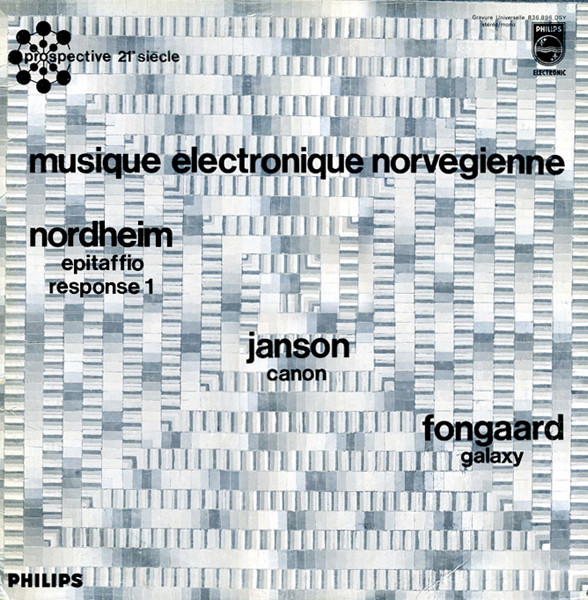
In France, the Norwegian Electronic and Pierre Henry releases came out under the Prospective 21e Siecle banner, the series with the amazing silver abstract pattern sleeves.


Also file under "dette var i morgen"


Crikey, hark at the cover of this other Four Front release


Thursday, July 11, 2024

Talking "sonic fiction" and Futuromania in LA (and beyond) - July 17


I'll be making a guest appearance at the Sci-Fi Short Story Club, discussing "The Sound-Sweep" - one of a couple of acutely imaginative tales involving music of the future dreamed up by J.G. Ballard.

The event, hosted by Los Angeles Public Library, is loosely tied to Futuromania - which features a extended essay about the ways in which science fiction writers have grappled with the challenge of imagining the future forms and functions of music.  So in addition to "The Sound-Sweep" and Ballard's work, the discussion will encompass the broader subject of the interface between s.f. + music

The book club meets by Zoom, so I can see no reason why - beyond issues of time zone differences -  someone who doesn't live in LA could attend, if they fancied. 

This free event takes place at 6 pm PDT, on Wednesday July 17th. 

Reading J.G.'s 1960 story in advance is helpful if you wish to participate in the discussion, but not essential. 

Sign up here. 


Sunday, July 7, 2024

Keen on chatting about necro-futurism

Here I am chatting with Andrew Keen for his show Keen On - about Futuromania, future-music, AI, and the intersection of science-fiction technology and retro culture - what you might term  (well, what I did term - a trial run for a coinage) necro-futurism.

I had a great chat with Andrew about a dozen years ago when Retromania came out - that time I went round to his HQ in San Francisco, sitting in a TV-style studio - so it was cool to bookend with this conversation, albeit this time done remotely. 

A Telex from yesterday's future

An example of what I call "the rhetorics of temporality" - the way critics compulsively position and reposition things they like, ...